Protecting Vulnerable
Young People
For caregivers of young people with autism, cognitive differences, or communication barriers — strategies that work across childhood and into adolescence.

Meet Dana and Jordan
Dana is the caregiver of Jordan, her 11-year-old son, who was diagnosed with autism spectrum disorder at age three. Jordan is non-verbal with a few functional words, uses a tablet for AAC communication, and has a deep passion for trains and Minecraft.
Like many caregivers across the country, Dana navigates Jordan's digital life with limited local specialist support and a lot of love. This course was built for families like hers.
Each module follows Dana and Jordan through real scenarios — the conversations, the close calls, and the strategies that make a difference.
What You Will Learn
Why young people with disabilities face elevated digital risk — and the specific factors that drive it
How to read behavioral warning signs when your child cannot tell you what happened
Practical safety settings and app choices calibrated to your child's specific needs
How to teach online safety using visual, concrete, repeatable methods — not abstract warnings
What changes as your child enters adolescence and how to stay ahead of evolving risks
How to build a coordinated safety team across home, school, therapy, and extended family
This course is for caregivers, not children. Content is frank and practical. Module 3 discusses grooming and exploitation in clinical detail. This information is here to equip you — not to alarm you. This course is educational only and does not replace advice from your child's clinical or educational team.
Understanding Vulnerability
Why young people with disabilities face elevated digital risk — and what makes the protective difference.

"Jordan figured out YouTube before I figured out the parental controls. By the time I locked it down, he had already found a channel I never would have approved. Not dangerous — just completely age-inappropriate. That was when I realized how far behind I already was."
The Gap No One Talks About
Research consistently shows that young people with disabilities experience abuse — including online abuse — at significantly higher rates than their peers. This is not because families are not caring or vigilant. It is because several factors combine to create real vulnerability.
The Communication Gap
When a child cannot reliably tell a trusted adult what happened, the normal protective mechanisms break down. This is not a failing of the child — it is a structural gap that bad actors actively look for. Children who are non-verbal or have limited expressive language are disproportionately targeted precisely because disclosure is difficult.
The Trust and Compliance Tendency
Many autistic young people are taught from an early age to trust adults, follow instructions, and comply with authority figures. These are valuable social skills — but they also make children less likely to refuse uncomfortable requests from someone who presents as friendly and authoritative online.
The Social Connection Drive
Autistic young people often experience genuine loneliness and a deep desire for peer connection that is hard to find face-to-face. Online spaces can feel like social equalizers. Someone offering friendship, acceptance, and a shared interest can build trust very quickly.
The Literal Interpretation Factor
Abstract warnings — "be careful online," "some people lie" — often do not land for literal thinkers. If a person has been consistently kind in a child's experience, the abstract warning does not create a protective filter. Concrete, specific, scenario-based safety education is far more effective.
Across much of the country — particularly in rural and underserved communities — access to pediatric specialists in autism, digital safety, and child protection is significantly more limited than in major urban centers. For many families, digital literacy is not a supplement to local specialist support — it is the primary protective layer.
What the Research Tells Us
Studies across multiple countries consistently find that children with disabilities are three to four times more likely to experience abuse than non-disabled peers. The online environment has expanded, not reduced, this exposure.
The protective factors are equally consistent: a trusted adult who is knowledgeable, consistent, and easy to disclose to. You do not need to be a specialist. You need to be present and informed — which is exactly what this course supports.
Statistics referenced in this course are drawn from published research including the Disrupting Harm series and CDC findings on disability and victimization. We encourage you to consult your child's pediatrician, psychologist, or ABA therapist for guidance specific to your child.
Which Factors Apply to Your Child?
Before continuing, consider which of these factors applies to your young person. This reflection will make Modules 4 and 5 more useful to you.
- Limited verbal or written disclosure ability
- Strong special interests that predictably structure online activity
- Preference for online over face-to-face social interaction
- Tendency to trust and comply with friendly adults
- High digital fluency within specific narrow domains
- Limited ability to recognize deception or manipulation
- Adolescent development alongside ongoing cognitive or communication differences
Module 1 Check-In
1. Which factor makes online spaces particularly appealing to many autistic young people?
2. Why are abstract warnings like "be careful online" often ineffective for literal thinkers?
3. The communication gap increases risk primarily because:
Their Digital World
How autistic and cognitively different young people actually use technology — and where the risks live.
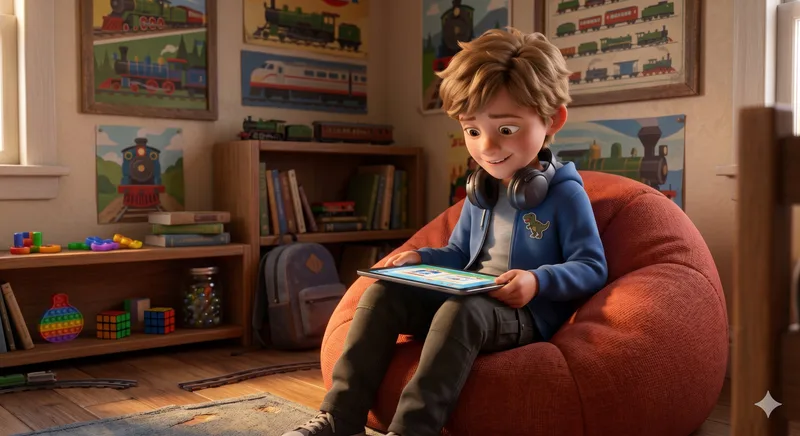
"Jordan can spend four hours in a Minecraft world without a break. He knows every biome, every crafting recipe, every mob behavior. He also watches the same five YouTube channels in a specific order every week. The routine is the safety — but it also creates predictability that someone else could learn."
Why Screens Feel Safe
For many autistic young people, screen-based environments offer something face-to-face interaction rarely does: predictability, control, and freedom from overwhelming sensory and social demands. In a video game, rules are consistent. There are no unexpected facial expressions to interpret, no ambiguous tones of voice. The screen is a regulated, manageable social space.
This is not a problem to be fixed. It is a genuine adaptive strategy. The protective task is understanding where that predictability can be disrupted — and by whom.
The Special Interest Entry Point
Special interests are one of the most distinctive features of autism — and one of the most significant risk factors online. A child intensely invested in trains, a specific video game, or a media franchise will seek out communities built around that interest. This is normal and healthy.
The risk: bad actors can learn a child's special interests quickly through public profiles, comment history, and viewing history — then use them as an entry point. "I love trains too" is a much faster path to trust than any general social approach.
Jordan watches the same five YouTube channels in the same order every Saturday morning. Dana knows this. A bad actor could know this too — from Jordan's comment history, his likes, and the "watch later" playlist he does not realize is public.
Cognitive Differences and Deception Detection
Children with autism are not naive. They are often highly intelligent, perceptive, and socially motivated. They are, however, frequently less skilled at detecting deception — particularly when someone presents as a friend who shares their interests.
The "theory of mind" concept describes the ability to understand that other people have different intentions than we do. This develops differently in many autistic individuals — meaning the internal alarm a neurotypical child might feel when something "seems off" about an online contact may not reliably fire.
Activity: Map Your Child's Digital Day
Priority actions for your child
Switch to YouTube Kids or enable Restricted Mode immediately. Set the content level by developmental stage, not calendar age. Review the public watch history and likes — make the account private or disable comments.
Set all multiplayer to Friends Only. For Minecraft, create a private Realm shared only with known contacts. For Roblox, disable trading and direct messaging. Usernames should not include real names, age, or location.
Discord has no age verification and private messaging is enabled by default. For most children with disabilities, Discord should be supervised or blocked until you have reviewed every server they're in and configured all privacy settings. Module 4 covers this in detail.
Review every public-facing profile on every platform. Username, avatar, bio, and location should reveal nothing identifying. Change privacy settings to "Friends Only" or equivalent on every platform.
Comment and like history is often public by default and creates a detailed map of your child's interests and routines. Review and clear existing history; set future activity to private where possible.
This is a priority action for this week. Set aside one hour to go through every app, every login, every username on your child's primary device. Module 4 includes a complete audit checklist.
Module 2 Check-In
1. Why do special interests create a specific online risk for autistic children?
2. The theory of mind difference matters in online safety primarily because:
3. Which of these is a common risk in Discord communities for autistic teens specifically?
Recognizing Warning Signs
What grooming and exploitation look like when your child cannot tell you what is happening.

Do not wait to complete this course. Contact your local law enforcement at 911 or the NCMEC CyberTipline at CyberTipline.org or 1-800-843-5678. Contact your child's pediatrician or a licensed trauma therapist before pursuing any conversation with your child about what happened. The information in this module is for prevention and early recognition — not incident response.
"Jordan started carrying his tablet everywhere. He had never done that before — he usually leaves it on the charger. Then he got upset when I asked to look at it. Not 'I am busy' upset. A full meltdown. Over a tablet. That was when I started paying closer attention."
The Grooming Playbook
Grooming is a deliberate, methodical process by which a bad actor builds trust with a child in order to gain access and normalize boundary violations. It is not impulsive — it takes time. And for children with autism, it is highly adapted.
Stage 1: Target Selection
Bad actors look for children who are isolated, seeking connection, and have limited disclosure ability. A child with a visible special interest, a public profile, and limited supervision is an attractive target. This selection happens before any contact — through public viewing history, comment sections, and social profiles.
Stage 2: Entry Through Shared Interest
First contact is almost always through something the child loves. "I love trains too." "Your Minecraft build is incredible." Flattery tied to a special interest builds trust at an accelerated pace with a child who rarely receives peer validation.
Stage 3: The Exclusive Relationship
The groomer positions themselves as the child's most important friend — one who "really understands" them. Communication moves to private channels. Secrecy is introduced gradually: "This is just between us." "Your mom would not understand." The child, who may have few close peer relationships, experiences this as genuine friendship.
Stage 4: Normalization and Testing
Small boundary violations are introduced and, when not refused, repeated and escalated. A request for a photo. A question about body parts framed as curiosity. Each step is calibrated to what the child has already accepted without objection.
For non-verbal or limited-verbal children, reporting what happened requires vocabulary, abstract recall, and an understanding that what occurred was wrong — all while managing loyalty to someone who felt like a real friend. Many children cannot bridge this barrier without a caregiver who knows the behavioral signals. A licensed trauma therapist can help create a safe disclosure pathway after an incident.
Behavioral Warning Signs
For children who cannot easily tell you what is happening, behavior becomes disclosure. These patterns — especially in combination — warrant calm, immediate attention:
- Changed relationship with a device: Suddenly protective, anxious when device is unavailable, or sudden disinterest in a previously loved platform
- New accounts, apps, or usernames you did not set up
- Unexpected gifts: Gift cards, gaming currency, or items "from a friend online"
- Behavioral changes: Increased stimming, sleep disruption, regression in toileting or eating, withdrawal, unexplained irritability
- Meltdowns specifically around device access or requests to review the device
- New vocabulary about body parts or sexual concepts they should not yet know
- Fear, shame, or anxiety that appears correlated with device use
Activity: Concerning or Typical?
Scenario A
Jordan gets upset when his tablet runs out of battery during a video. He has a brief meltdown and calms down once it recharges.
Scenario B
Jordan becomes unusually distressed when Dana asks to look at his tablet after noticing he has been using it in his room with the door closed. He hides the screen and begins crying.
Scenario C
Jordan pulls Dana over to the tablet to show her a train layout he built in Minecraft. He seems proud and points enthusiastically at the screen.
Scenario D
Jordan has a new Minecraft username Dana did not set up. When she asks about it, he becomes very agitated, avoids eye contact, and leaves the room.
Creating a Disclosure Pathway
A disclosure pathway is a pre-established, practiced way for your child to signal that something happened — even without words.
- AAC vocabulary: Work with your child's SLP to add body safety vocabulary — "This feels wrong" and "I need help" are high-priority additions.
- Visual cue systems: A simple color-coded card kept near devices can give non-verbal children a reporting mechanism. Practice using it at calm moments.
- Predictable device check-ins: A shared routine review of the device normalizes caregiver access and reduces the likelihood that a child will feel unable to show you something concerning.
- Trusted adult network: Ensure your child has two to three consistent trusted adults who know the behavioral warning signs — not just verbal disclosure signals.
If your child uses AAC, your Speech-Language Pathologist is the right first contact for adding safety vocabulary. They can ensure the vocabulary is introduced appropriately and supported across settings. This course cannot substitute for that professional relationship.
Module 3 Check-In
1. Grooming typically begins by:
2. For non-verbal children, the primary disclosure mechanism caregivers need to watch is:
3. A disclosure pathway is most valuable because:
Safe Digital Environments
Practical controls, app choices, and monitoring strategies calibrated to your child's needs.
"I did not want to take away his tablet. That felt punitive — and wrong. What I wanted was to understand what was on it and to make the unsafe parts actually inaccessible. It took about two hours to go through everything. I wish I had done it two years earlier."
Monitoring vs. Surveillance
The goal is monitoring, not surveillance. Monitoring means maintaining visibility as part of your relationship. Surveillance means covert tracking that, if discovered, destroys trust.
For children who use AAC and rely on their devices for communication, removing device access as punishment is almost never appropriate — it is equivalent to removing speech. The framing should always be about access configuration, not device removal.
Your child should know you can see what they do online. "I look at your tablet sometimes, just like I check in on your schoolwork" is the tone to establish — transparent, routine, and part of the relationship.
Device-Level Controls
iOS — Screen Time
- Settings → Screen Time → set a passcode only you know
- Content & Privacy Restrictions → enable for your child's developmental level
- Communication Limits → set to "Specific Contacts" only
- Web Content → "Allowed Websites Only" for most vulnerable children
- Always Allow: AAC app, family video call apps — never block these
Android — Google Family Link
- family.google.com — create a supervised account for your child
- Require your approval before any new app installs
- Enable Google Safe Search and YouTube Supervised Mode
- Review activity reports: apps used and duration
Some parental controls can inadvertently block AAC functionality. Work with your child's SLP before changing any settings on a device used for communication, and test thoroughly after every configuration change.
Platform Configuration Quick Reference
YouTube / YouTube Kids
- YouTube Kids recommended under 13 — set content level by developmental stage, not calendar age
- Custom mode: disable search entirely; provide only hand-selected channels
- If using standard YouTube: Restricted Mode ON; review comment history monthly
Minecraft Bedrock
- Microsoft Family Safety: link accounts; set multiplayer to Friends Only
- Use a private Realm shared only with known contacts
- Username: no real name, age, or location
Roblox
- Account Settings → Privacy → all communication to "Friends" only
- Enable Account PIN; disable trading and direct messaging for vulnerable children
AAC Apps
- Proloquo2Go, Snap Core First, TouchChat — always accessible, no restrictions
- Review vocabulary pages periodically — new pages can reveal experiences the child wants to communicate
Activity: Safety Audit
Module 4 Check-In
1. For a child who uses their tablet as an AAC communication device, restrictions should be:
2. The key difference between monitoring and surveillance is:
3. For Minecraft, which setting most directly reduces risk of contact with unknown adults?
Teaching in Their Language
Visual supports, social stories, and concrete routines — not abstract warnings.
"We made a poster together. It has five rules with little drawings Jordan helped make. Rule one is a picture of a lock that says 'My address is private.' Rule four is a red hand that says 'No photos of my body.' That was a year ago. He still touches that poster when he walks past it."
From Abstract to Concrete
The most common mistake in online safety education for children with disabilities is using the same abstract language used for neurotypical children. "Be careful online." "Protect your private information." These instructions lack the specificity that makes them actionable for concrete thinkers.
Effective safety education for this population requires:
- Concrete, specific rules rather than general principles
- Visual supports that reinforce the rules where they are needed — next to the device, on the bedroom wall
- Regular repetition as part of routine, not a one-time conversation
- Role-play and scenario practice adapted to your child's communication level
- Consistent language across all caregivers, teachers, and support staff
The strategies in this module are most effective when coordinated with your child's Speech-Language Pathologist, ABA therapist, special education teacher, and other providers. This course provides a framework — professionals who know your child can tailor implementation to their specific needs and communication style.
The Body Safety Connection
One of the most effective frameworks for online safety with this population leverages body safety concepts many children have already learned. The parallel is direct and concrete:
"Just like no one should touch your private body parts, no one should ask for private information about your body online. Private information includes: photos of your body, your home address, your school name, and your phone number."
This framing works because it connects to existing knowledge, uses concrete language, and applies the same rule across all environments — at school, at home, and online.
The 3-R Framework (Adapted)
- Recognize: Practice identifying "this feels wrong" using a visual feelings scale or emoji indicator.
- Refuse: A pre-programmed AAC phrase or scripted verbal response: "I have to go. Goodbye." Practice until automatic. No explanation required.
- Report: Use the disclosure pathway from Module 3. Practice this too — at calm moments, not only in a crisis.
Build Your Child's Safety Story
Fill in the fields above to generate your personalized safety story.
Building the Safety Routine
Safety rules taught once and not revisited rarely stick — especially for children who benefit from repetition. Build these into existing routines:
- Pre-device visual check: A laminated card next to the charging station with three to five rules in pictographic form. The child sees it every time they pick up the device.
- Weekly check-in: A brief, positive, shared review — "show me what you have been watching this week." This normalizes caregiver access without interrogation.
- Monthly story review: Re-read the safety story at a calm, routine moment — proactively, not after an incident.
- Consistent language across the team: Share your exact phrases and visual supports with teachers, therapists, paraprofessionals, and respite caregivers.
Module 5 Check-In
1. The "private parts = private information" framework is effective primarily because:
2. For a non-verbal child, the "Refuse" step is best implemented as:
3. Safety education should be revisited:
Into Adolescence
What changes when your child enters their teen years — and how to stay ahead of evolving risks.
"His body is changing. His interests are shifting. He has found a Discord server for a train enthusiast community — mostly adults, very kind, very knowledgeable. And I have no idea what happens in the private messages. That is the part that keeps me up at night."
Why Adolescence Changes Everything
The Connection Imperative
The developmental drive toward belonging, peer identity, and romantic interest intensifies during adolescence — and for autistic teens, this often happens alongside limited social scripts and fewer peer relationships. Online communities can become primary social worlds. The investment is intense and real.
Sexual Development Without Social Scripts
Autistic teens experience the same sexual development as their neurotypical peers but often without the informal social education that provides context. This creates specific vulnerability to romantic and sexual exploitation by adults who position themselves as experienced guides.
Increased Access, Decreased Supervision
Adolescence often brings increased device independence — a personal phone, more privacy. This is developmentally appropriate to a point, but requires active recalibration of oversight rather than passive reduction of it.
Sextortion is the coercion of young people into providing sexual images, which are then used as leverage to demand more. Teens with autism are disproportionately targeted — the social scripts for recognizing this manipulation are often less developed, and the shame that sustains silence is especially effective. If you believe your teen has been targeted, contact NCMEC at 1-800-843-5678 and consult a licensed trauma therapist.
The IEP Opportunity
If your child has an Individualized Education Program, adolescence is the right time to add explicit digital safety goals. These might include:
- Identifying trusted adults across settings
- Identifying "private information" using visual supports
- Practicing the 3-R response in role-play scenarios
- Body autonomy and consent language appropriate to developmental stage
- Understanding that online friends are not always who they say they are
Request that digital safety be a standing agenda item at IEP meetings. Consult your child's special education case manager about how to incorporate these goals effectively within their existing plan.
Building the Safety Team
For adolescents with disabilities, online safety cannot rest with one caregiver alone. These people need shared awareness of your child's safety plan:
- Special education teacher / case manager
- Paraprofessionals / aides — must know the disclosure pathway and warning signs
- Speech-Language Pathologist — key partner for AAC body safety vocabulary
- Therapist / Psychologist — can build safety scenarios into therapeutic work
- Respite caregivers and extended family — must use the same device rules and language consistently
Activity: Adolescence Readiness Checklist
Module 6 Check-In
1. Sextortion specifically targets autistic teens because:
2. Adding digital safety goals to an IEP is appropriate because:
3. As a teen gains more device independence, oversight should:
Certificate of Completion
Has completed all six modules of this educational course on digital safety strategies for caregivers of young people with autism, cognitive differences, and communication barriers.
Your Personalized Safety Plan
Reminder: This safety plan is a starting framework based on your course responses. It does not replace a professional safety assessment. Share this with your child's pediatrician, SLP, ABA therapist, and special education case manager. They can help you refine and implement it effectively for your specific child.